+121°
📄Office & copy paper
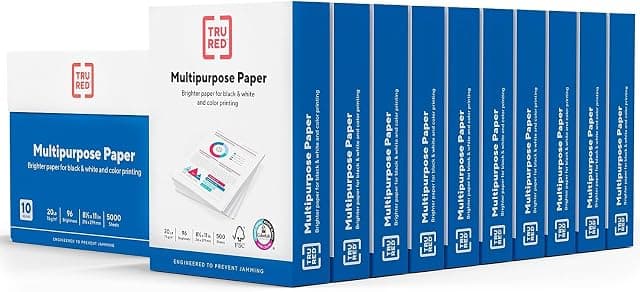
TRU RED Multipurpose Paper 8.5 x 11 Inch 20 lb 96 Bright White
$0.011Cost / sheet
Price checked Jul 21 · confirm on Amazon🔥 Popularpack price$56.99
TRU RED · Amazon
See on Amazon Standard copy paper is 20 lb bond = 75 gsm; cardstock runs 65–100 lb cover (176–271 gsm). The catch that confuses everyone: US lb “basis weight” is only comparable within a paper family (bond, text, cover, index each use a different reference size) — so GSM is the only weight you can compare across types. Below is the full conversion.
| Family | US weight | GSM | Typical use |
|---|---|---|---|
| Bond / Writing | 20 lb bond | 75 | Everyday copy & printer paper |
| Bond / Writing | 24 lb bond | 90 | Letterhead, résumés, nicer double-sided |
| Bond / Writing | 28 lb bond | 105 | Premium documents, presentations |
| Bond / Writing | 32 lb bond | 120 | Heavy premium paper, brochures |
| Text / Book | 70 lb text | 104 | Flyers, booklet interiors |
| Text / Book | 80 lb text | 118 | Quality brochures, catalogues |
| Text / Book | 100 lb text | 148 | Premium flyers, magazine pages |
| Cover / Cardstock | 65 lb cover | 176 | Light cardstock, postcards |
| Cover / Cardstock | 80 lb cover | 216 | Business cards, folders, covers |
| Cover / Cardstock | 100 lb cover | 271 | Heavy cards, invitations |
| Index | 90 lb index | 163 | Index cards, tabs |
| Index | 110 lb index | 199 | Sturdy index cards, dividers |
Standard industry conversions; exact GSM varies slightly by mill. GSM is comparable across all families; lb basis weight is not.
Live from the catalog, ranked by real cost per sheet — cheapest first.
TRU RED Multipurpose Paper 8.5 x 11 Inch 20 lb 96 Bright White
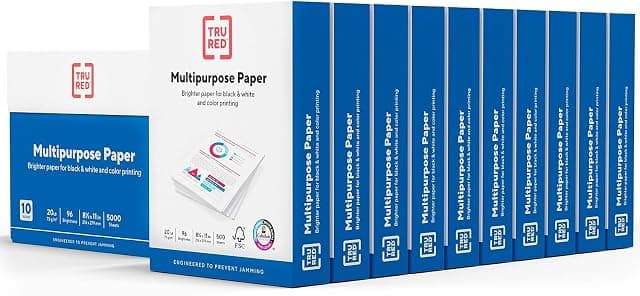
TRU RED Printer Paper, 8.5 x 11, 20 lb, For Office, School…
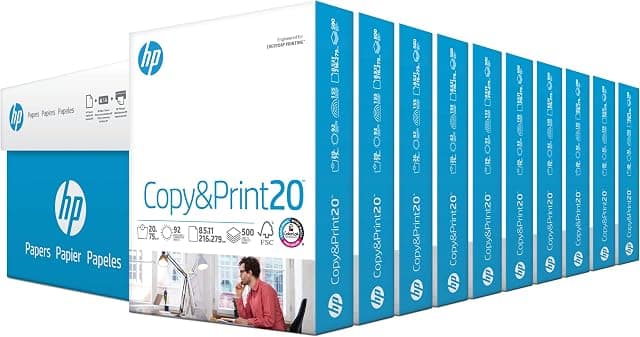
HP Printer Paper | 8.5 x 11 | Copy & Print 20 lb | 10 Ream…
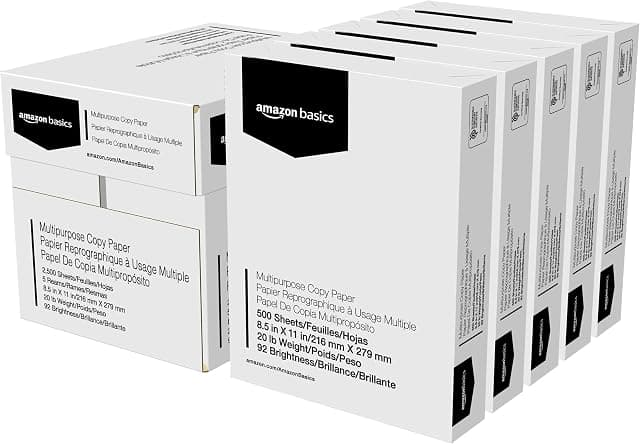
Amazon Basics Multipurpose Copy Printer Paper
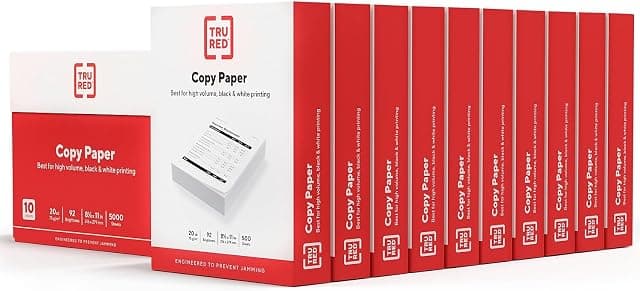
Staples TRU RED Copy & Printer Paper
A paper’s lb “basis weight” is the weight of 500 sheets at that family’s standard parent-sheet size — and bond, text, cover and index each use a different parent size. That’s why a 20 lb bond, a 50 lb text and a 27 lb cover can weigh almost the same. GSM is measured the same way for every paper, so it’s the one figure you can trust to compare thickness across types. When a product lists both, read the GSM.
Standard copy and printer paper is 20 lb bond, which is 75 gsm. Slightly heavier 24 lb bond (90 gsm) feels more substantial and is better for double-sided printing and letterhead because less shows through. Anything at or above 32 lb bond (120 gsm) starts to feel like premium stationery.
Because US "basis weight" is the weight of 500 sheets of that paper at its family's standard parent-sheet size — and each family (bond, text, cover, index) uses a different parent size. So a 20 lb bond, a 50 lb text and a 27 lb cover can all weigh nearly the same in real terms. GSM (grams per square metre) is measured the same way for every paper, so it is the only weight you can compare directly across types. When in doubt, compare GSM.
Cardstock is in the "cover" family and typically runs 65 lb cover (176 gsm) for light cardstock up to 100 lb cover (271 gsm) for heavy cards. 65 lb cover suits postcards and craft projects; 80 lb cover (216 gsm) is the common business-card and folder weight; 100 lb cover is stiff, premium invitation stock. Note that 110 lb index (199 gsm) is a separate, slightly different card paper often sold for index cards.
Yes — heavier paper uses more material per sheet, so cardstock and cover weights cost more per sheet than everyday 20 lb copy paper. For routine documents there is no benefit to paying for a heavier weight; save it for the pieces that need to feel substantial, like résumés, covers and cards. As always, compare cost per sheet, not the pack price.